Choosing the right child car seats for your little ones can be very confusing. There are several different types of car seat on the market. Here we take the confusion out of the process to make buying a car seat that little bit easier.
Know the law
UK law states that a child MUST use a child car seat until they’re either, 12-years-old or 135cm tall, whichever comes first.
Children over the age of 12 or taller than 135cm MUST wear a seat belt.
The safest way for children to travel in cars is in a child car seat that is suitable for their weight and size and is correctly fitted in the car.
However, if you don’t make sure any child passengers have the right car seat, in accordance with the law, and they’re injured or killed in an accident, your car insurance may not cover you. Even if that is temporary car insurance.
What are the penalties for not wearing a seatbelt or child restraint?
If you fail to ensure child passengers (under 12 or 135cm tall) are suitably restrained, you may receive a TOR (Traffic Offence Report), which could result in you having to attend an awareness course, pay a £100 fine OR if the matter goes to court this amount could increase to £500!
What are the laws for booster seats in the UK?
You can legally use a booster seat in the UK, but the rules vary depending on the age of the seat and the weight of your child.
The laws for using a booster seat in the UK are:
- Children must use a child car seat or suitable booster seat until they’re 12 years old or 135 centimetres tall, whichever comes first
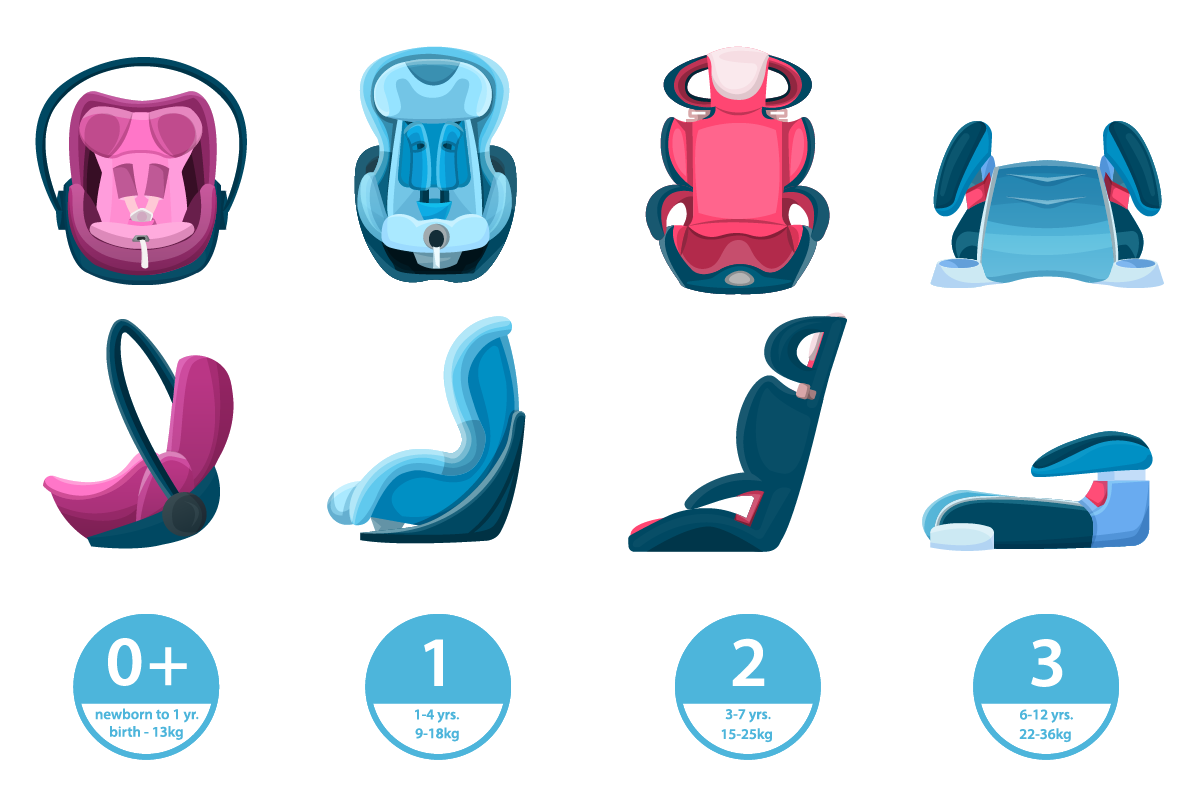
- A backless booster seat should only be used by children who are taller than 125cm and weighing more than 22kg
- High-back booster seats can be used by children who weigh between 15-36kg
Older backless booster seats (manufactured before March 2017) can still legally be used by a child weighing 15-36kg but this is not recommended by child seat experts.

Choosing the right car seat
To ensure your child travels in an appropriate child restraint, please follow these guidelines:
- Only seats approved by the EU are legal in the UK
- Height-based child seats are called i-Size seats should have a label with a capital ‘E’ in a circle and ‘ECE R129’
- Weight-based child seats should have a label with a capital ‘E’ in a circle and ‘ECE R44’
- Child seats must be fitted using ISOFIX mountings or a diagonal seat belt strap
- Seats must be correctly fitted according to the manufacturer’s instructions.
Rear-facing seats offers the best protection for toddlers and babies. If you use an i-Size child seat, children must be rear-facing up to 15 months old. Never fit a rear-facing child seat in the front if there is an active airbag on the passenger side of the car.
Children weighing more than 22kg or taller than 125cm can use a backless booster seat. For smaller children, a highback booster seat is recommended.
Is it safe to use a second-hand child seat?
Whilst you could save money by purchasing a second-hand child seat, it is far safer to buy new.
If using a second-hand seat, only accept one from family or friends you trust and you’re certain you know its history, it comes with the original instructions and is not too old.
Rear-Facing Child Car Seats: Keeping Children Safer for Longer
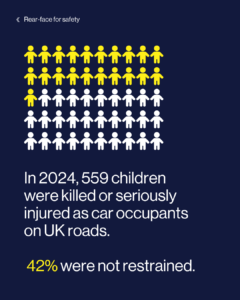 Current UK law requires children to use an appropriate child car seat until they are 12 years old or 135cm tall, whichever comes first. However, while many children move into forward-facing seats at a young age, safety experts recommend keeping children rear-facing for as long as possible within the limits of their car seat.
Research shows that children can be up to five times safer travelling rear-facing compared with forward-facing. Rear-facing seats provide greater protection for a child’s head, neck and spine, particularly in frontal collisions, which are among the most serious types of road traffic collisions.
Young children have proportionally larger and heavier heads than adults, while their necks and spines are still developing. A rear-facing seat helps spread crash forces across the child’s entire back, reducing the strain placed on these vulnerable areas.
For this reason, road safety organisations and child safety experts encourage parents and carers to keep children rear-facing until at least four years old, and longer where the seat and child’s size allow.
Key Advice
- Always use a child car seat that is suitable for your child’s height and weight.
- Follow the manufacturer’s instructions carefully when fitting and using the seat.
- Keep children rear-facing for as long as possible within the limits of their car seat.
- Consider choosing an extended rear-facing seat that allows children to remain rear-facing until at least four years old.
- Have your car seat checked by a trained retailer or fitting service if you are unsure it is installed correctly.
Find Out More
When choosing a child car seat, look for models that allow extended rear-facing travel and ensure the seat is suitable for your child’s height, weight and age. If you are unsure which seat is right for your child, seek advice from a reputable retailer or child car seat specialist.
-
Why is rear-facing considered safer?
In a frontal collision, a rear-facing seat supports the child’s head, neck and spine by distributing crash forces across the back of the seat. This reduces the forces acting on a young child’s developing body and provides significantly greater protection than a forward-facing seat. Evidence indicates children can be up to five times safer travelling rear-facing.
-
Until what age should my child remain rear-facing?
Safety experts recommend keeping children rear-facing until at least four years old, and preferably longer where their car seat and size allow. Many modern rear-facing seats are designed to accommodate children well beyond infancy.
-
Isn't my child too big to travel rear-facing?
Not necessarily. Many parents are surprised by how long children can comfortably travel rear-facing. Always follow the height and weight limits specified by the seat manufacturer.
-
There doesn't seem to be enough room for my child's legs. Will they be uncomfortable?
Children are generally much more flexible than adults and often sit comfortably with their legs bent, crossed or resting against the vehicle seat. Many rear-facing seats are specifically designed to provide good legroom as children grow.
-
Are children more likely to injure their legs in a rear-facing seat?
No. Research shows that leg injuries are uncommon for children travelling rear-facing. Rear-facing seats are designed to protect the head, neck and spine, which are the areas most vulnerable to serious injury in a collision.
-
My child wants to face forwards. What should I do?
It is natural for children to be curious about facing forwards. However, safety experts recommend keeping children rear-facing for as long as possible within the limits of their seat because of the additional protection it provides.
-
Won't my child get bored or be unable to see out?
Won’t my child get bored or be unable to see out?
-
My child suffers from travel sickness. Is rear-facing the cause?
Not necessarily. Motion sickness is generally linked to how the brain processes movement rather than the direction a child is facing. Practical measures such as keeping the vehicle cool and ensuring the child can see out of the window may help.
-
I only drive short distances. Does rear-facing still matter?
Yes. Many collisions occur close to home, and even careful drivers cannot control the actions of others on the road. Choosing the safest option for your child is important on every journey, regardless of distance.
-
Are rear-facing car seats legal in the UK?
Yes. Rear-facing car seats are legal and widely available in the UK. Parents and carers should always follow the manufacturer’s guidance on installation, height and weight limits.
-
Does rear-facing only matter for babies?
No. While rear-facing is especially important for babies, the safety benefits continue as children grow. Keeping children rear-facing for longer helps provide better protection for the head, neck and spine throughout early childhood.